
What are Competitor Insights?
Competitor Insights are a concise analysis of competing companies: what they offer, who they target, how they position and price themselves, and what they’ve been doing recently.
What “Competitor Insights” Means
For a typical startup, Competitor Insights is an ongoing view of what competing businesses are offering, how they’re trying to win customers, and what those changes might mean for your own decisions.
It turns scattered signals—websites, pricing pages, product announcements, customer reviews, job postings, ads, and news—into a clearer picture of the market. The goal isn’t just to know what competitors are doing. It’s to help answer questions like:
- Are customers starting to expect a feature we don’t have?
- Is a competitor changing its target customer or message?
- Are we priced too high, too low, or just differently?
- Where might there be an opening for us?
A Startup Example
Imagine a startup that sells software to help small businesses manage employee expenses. It competes with both established expense platforms and newer finance tools.
A useful insight might look like this:
Several competitors are emphasizing faster reimbursements. Two updated their homepages to mention same-day or next-day payouts, and recent customer reviews complain about reimbursement delays at other providers.
Why it matters: Speed may be becoming a more important buying factor for small businesses.
Possible action: Check whether your product can support faster payouts, and consider testing “reimburse employees faster” in your website messaging.
That’s more useful than simply recording that two competitors changed their websites. It connects the evidence to a possible customer need and a decision the startup could investigate.
What it Can Include
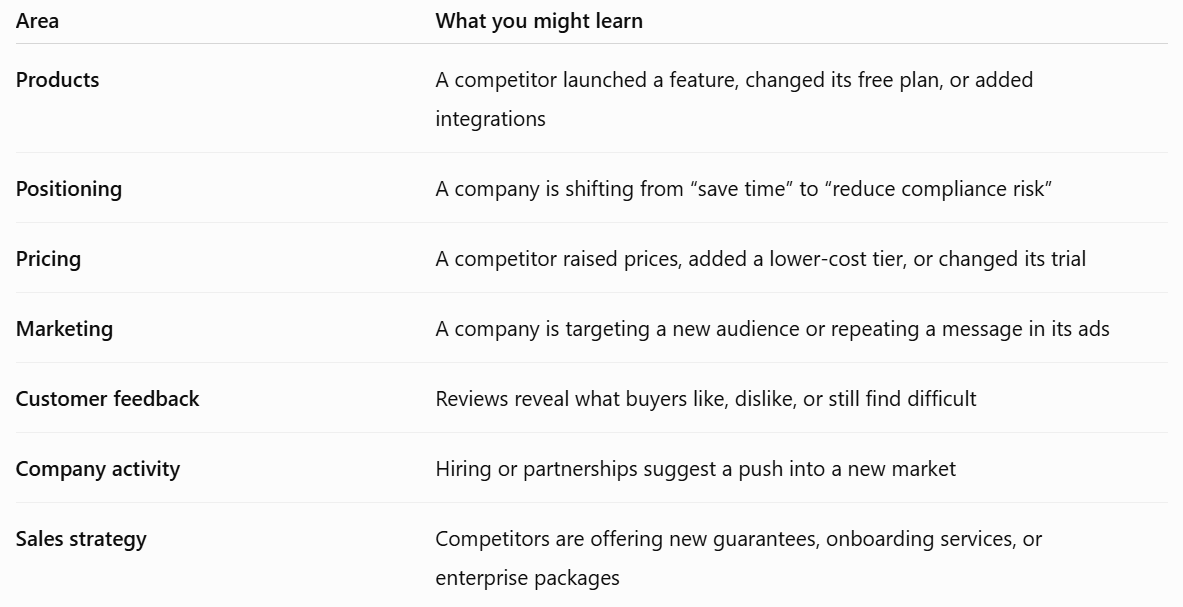
A competitor changes its pricing.
A scheduling startup notices that a major competitor has removed its free plan and introduced a paid tier for teams of three or more. That could create an opportunity to attract very small teams—or indicate that the competitor is focusing on customers with larger budgets. The startup should check whether its own free plan brings in customers who later pay.
A competitor starts targeting a different buyer.
A design tool that once marketed to individual creators begins publishing material for marketing departments and hiring enterprise salespeople. That may signal a move upmarket. A smaller startup might decide to focus its message on freelancers and small studios, where the larger company’s product feels too complex.
Customers repeatedly complain about setup.
Reviews across several competing products mention difficult onboarding. A startup could make setup easier, then demonstrate that advantage with a guided trial or a clear “get started in 10 minutes” promise—if it can support that claim.
A competitor launches a feature you already planned.
That’s a reason to revisit the plan, not automatically to copy the feature. The startup might ask whether its customers need the same thing, whether it can do it better, or whether another problem is more valuable to solve.
What Makes an Insight Useful
A strong competitor insight includes the signal, the evidence, why it may matter, and a practical question or next step. It should distinguish observed facts from interpretation. For example, “the competitor added a new enterprise sales role” is an observation; “they’re moving upmarket” is a reasonable interpretation, but it still needs confirmation.
Competitor insights can inform product, pricing, positioning, and sales decisions. They’re best treated as input to your judgment, not a substitute for talking with customers or deciding what your startup should stand for.