
What is the Difference Between Competitors and Direct Competitors?
Understand how startups define competitors and direct competitors, with examples of rivals, substitutes, customer alternatives, and why the distinction matters.
Competitors vs. Direct Competitors
For a startup, competitors are all the products, services, or workarounds a customer might choose instead of yours. Direct competitors are the closest subset: they target similar customers and solve the same problem in a similar way.
So, every direct competitor is a competitor, but many competitors aren’t direct competitors.
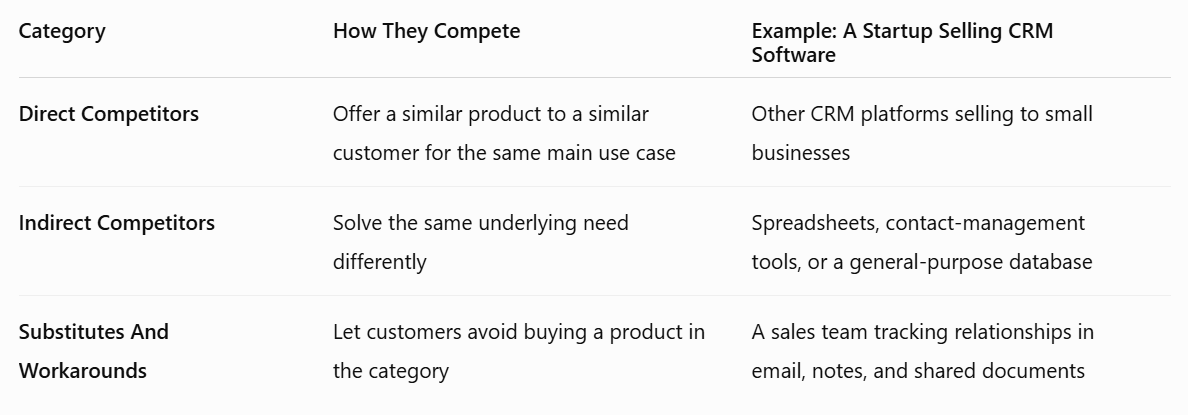
Examples for Startups:
Project management software: If a startup sells a project management app for small creative agencies, other project management apps targeting agencies are direct competitors. A spreadsheet or a team’s existing combination of Slack, email, and shared documents is an indirect competitor or workaround.
Meal delivery: A prepared-meal startup directly competes with similar meal-delivery services. Grocery delivery, takeout, meal kits, and cooking at home compete for the same dinner budget, but they meet the need differently.
Hiring software: An applicant-tracking startup directly competes with other applicant-tracking systems. A staffing agency, a recruiting firm, or a company’s manual process may be an alternative way to fill the same roles.
Property research software: A startup that helps commercial real estate investors find properties may directly compete with similar property-search platforms. Brokers, public-record searches, spreadsheets, or an investor’s internal research team could also be alternatives.
Why The Distinction Matters
Startups often focus too narrowly on direct competitors and miss what customers actually compare against. A prospective customer may not be choosing between your startup and a similar vendor. They may be deciding whether to buy anything at all, keep using a manual process, or solve a different problem first.
Mapping both groups helps a startup:
- Position its product: Explain why it’s a better choice than close rivals and current workarounds.
- Set pricing: Understand what customers pay now, including the cost of staff time or existing tools.
- Prioritize product features: Identify what customers expect from products in the category and what would make them switch.
- Size the opportunity: Avoid assuming that every company in a broad market is a direct rival—or that only direct rivals affect demand.
- Prepare for sales conversations: Learn which alternatives prospects are actually considering.
A useful test is: When a customer decides whether to buy your product, what other options do they seriously consider? The similar vendors on that shortlist are usually your direct competitors. The other ways they could meet the need are competitors or substitutes in the broader sense.